In the previous article we saw what CFD simulation is and where it is applied, including HVAC system design calculations. In this article we look at:
- Why CFD simulation is needed in the HVAC field.
- The applications and the value CFD brings to the HVAC design process.
Why CFD simulation is needed in the HVAC field
HVAC stands for Heating, Ventilation and Air Conditioning — the system that creates thermal comfort and maintains indoor air quality through every season of the year. Conventionally, HVAC design calculations assume “ideal flow” (air perfectly mixed in an infinitely short time) and use handbooks and estimation formulas so the calculation stays quick and simple. That approach can lead to poorly sized HVAC equipment, raising operating costs and lowering energy efficiency. A design verification tool is therefore needed before construction. To verify a design, engineers can build a physical test model or run a CFD simulation at real operating conditions. Large corporations such as SAMSUNG, LG, DAIKIN and Ramboll use CFD widely for the benefits outlined below.
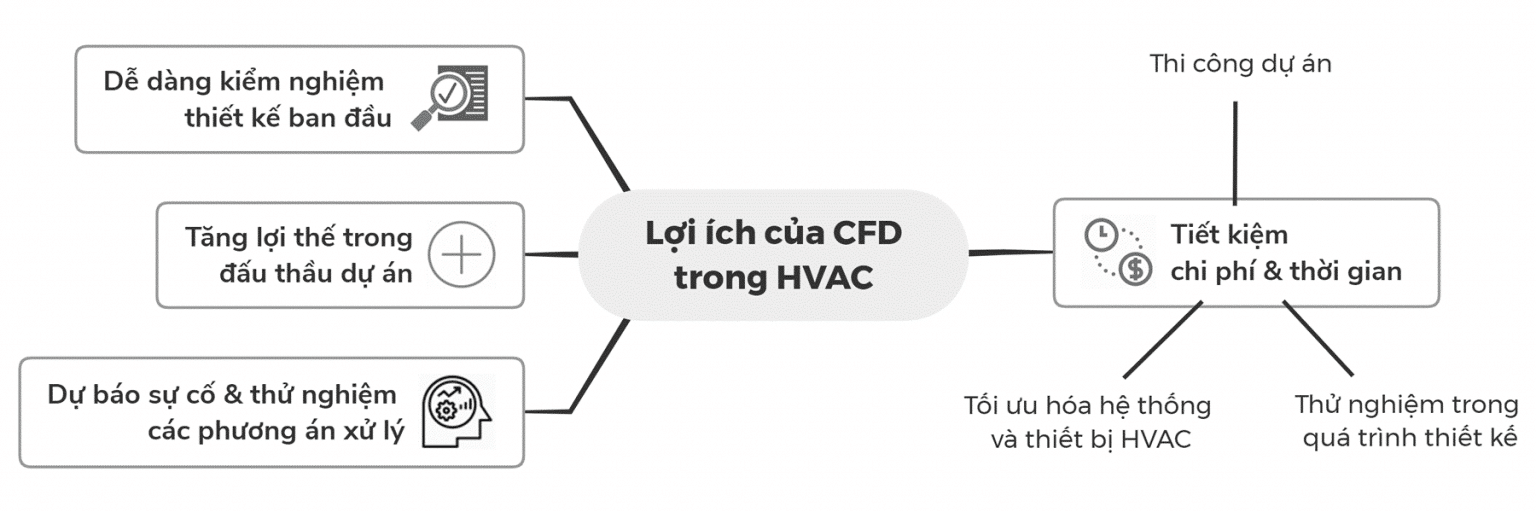
The benefits of CFD simulation in HVAC
Simulating the comfort indices in HVAC
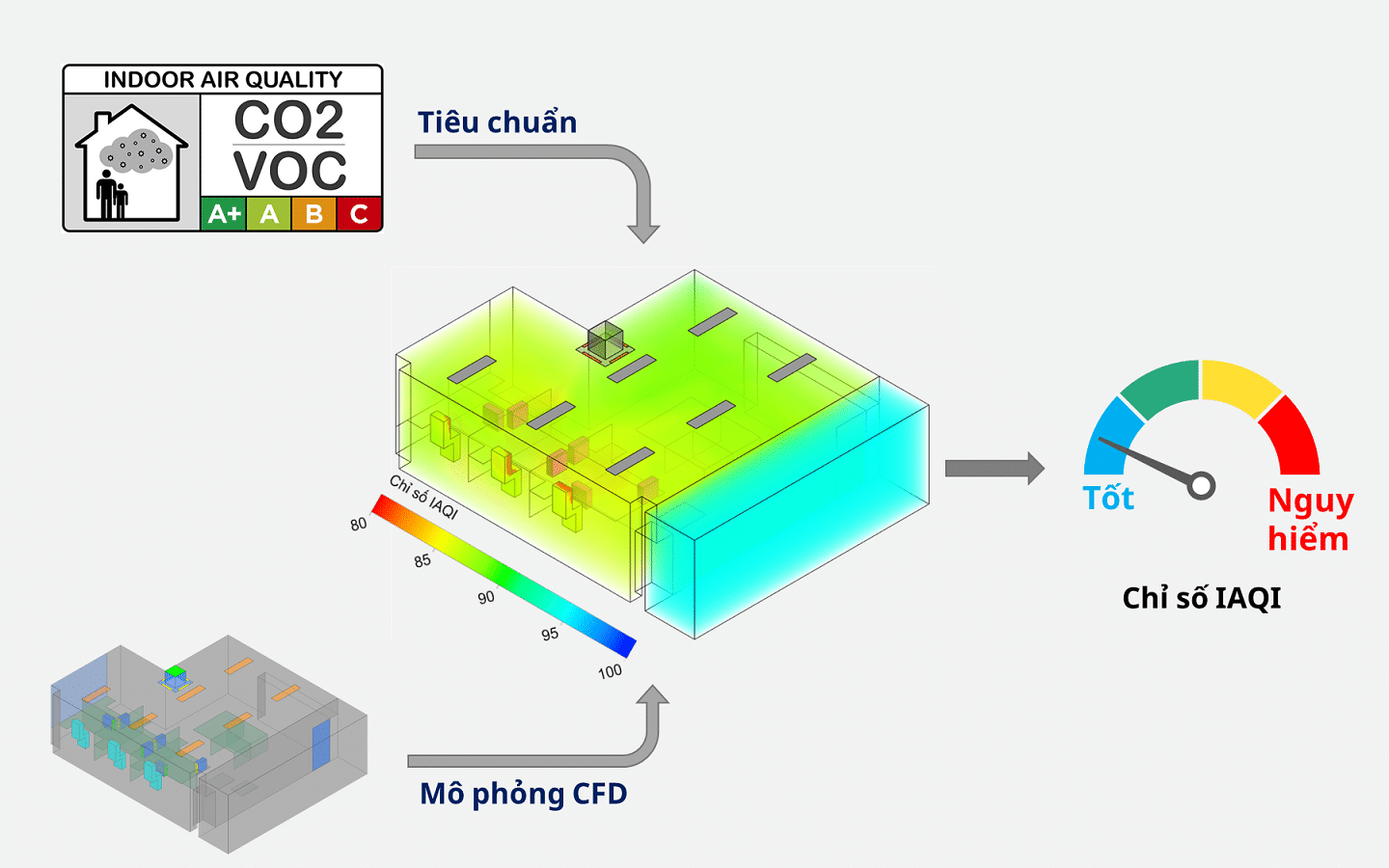
Comfort indices for the indoor air environment cover thermal comfort (temperature, humidity and air velocity, plus the derived comfort indices) and indoor air quality (dust, odor, toxic gas, bacteria and virus concentrations). These indices express not only how comfortable people are in a space (homes, cinemas, classrooms and so on) but also requirements set out explicitly in standards such as ASHRAE 55 (USA), ISO 7730 (international) and TCVN 7438 (Vietnam). They depend on real conditions that change with time, on how the furniture is arranged, and on other factors — which is why conventional calculation methods struggle to meet comfort requirements. CFD simulation lets engineers visualize and assess comfort indices in either steady or transient state. Some of the value CFD brings:
- Computing the distribution of comfort indices, verifying the design and optimizing HVAC system performance by simulating these indices at the early design stage.
- Identifying areas that fail to meet comfort requirements, assessing the influence of the factors involved, and verifying the fix.
- Changing the HVAC design and the furniture layout (where needed) to optimize the comfort indices and meet the requirements and standards fixed during design.
- Analyzing and testing HVAC improvements for buildings already in operation.
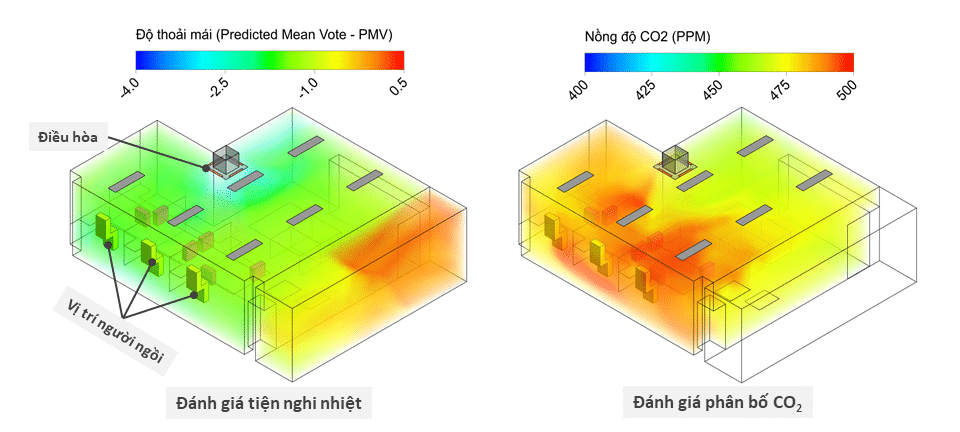
Thermal comfort and CO2 distribution in an office [source]
(in the left-hand image, orange marks the most comfortable positions, where PMV = 0)
Simulating flow analysis in HVAC
Inside a building, beyond the comfort indices already mentioned, other problems also call for CFD: (1) the dispersion of dust and pollutants (homes, car parks, factories), (2) the mean age of air in a room, (3) fire safety, and so on.
CFD is also used to assess how the indoor and outdoor environments affect each other, mainly through: (1) solar radiation entering the building, (2) dust and toxic gas migrating in from outside, (3) heat loss through the building envelope, and (4) natural and forced ventilation. By iterating the design or changing the imposed conditions, engineers can readily achieve several important goals:
- Predicting what happens in an incident, and testing prevention and mitigation options at the early design stage.
- Optimizing dust and toxic gas treatment, and fire safety systems (for example smoke control).
- Assessing how external factors (solar radiation, dust, humidity, toxic gas) affect the indoor comfort indices.
- Verifying the design and performance of the ventilation system.
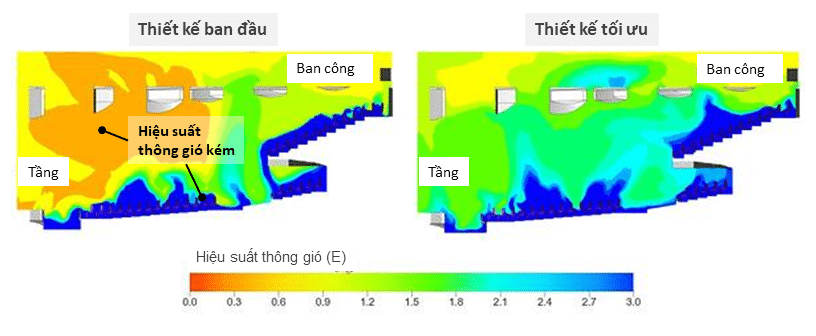
CFD applied to forced ventilation system design [source]
(red marks the positions with the poorest ventilation effectiveness)
Simulating to optimize HVAC equipment
CFD lets design engineers assess indices such as performance, energy efficiency, noise and residence time for HVAC equipment, including: (1) air cleaning equipment, (2) air conditioners (AC), (3) air handling units (AHU), (4) burners and boilers, (5) chillers, (6) diffusers, (7) heat exchange coils, (8) humidity treatment equipment, (9) heaters, (10) pumps, fans, compressors and ductwork, and (11) refrigeration units. Simulation brings a great deal of value to design engineers and manufacturers, for example:
- Keeping the number of physical prototypes built for testing during design to a minimum.
- Detecting latent problems in the first steps of the design process.
- Optimizing the shape and performance of HVAC equipment, particularly equipment fitted into tight spaces such as cars, ships, trains and aircraft.
- Analyzing and testing improvements to ductwork and grilles in buildings already in operation.
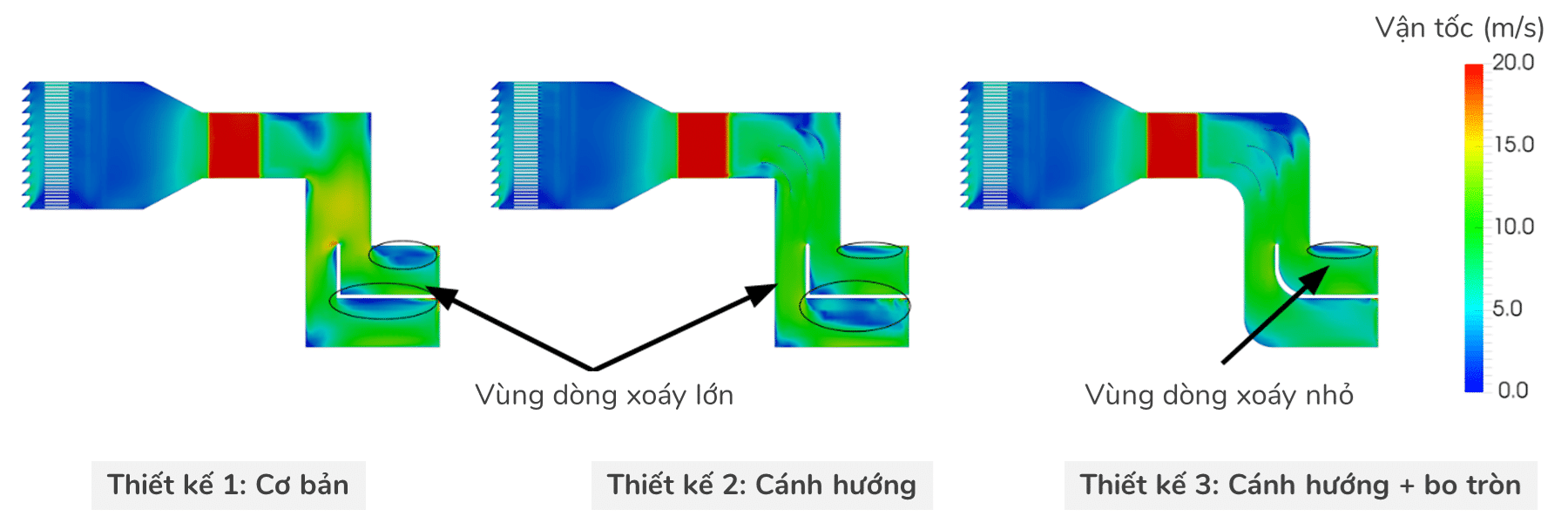
Duct design using CFD simulation [source]
Simulating to optimize HVAC system energy use
Energy models are usually also based on the “ideal flow” assumption. In reality the air mass in a building stratifies with height and is uneven in both space and time. Even the most carefully computed energy model therefore needs a further verification tool [source]. By fixing the indoor conditions and varying the outdoor ones, CFD is an effective way to verify and optimize a building's energy use. The value CFD brings to HVAC energy optimization:
- Verifying “energy saving ideas” at the early design stage, so the HVAC system can reach high energy efficiency.
- Removing unnecessary elements, raising the energy efficiency of the whole HVAC system.
- Creating a database for energy models that can be used in IoT (internet of things) and digital twin applications.
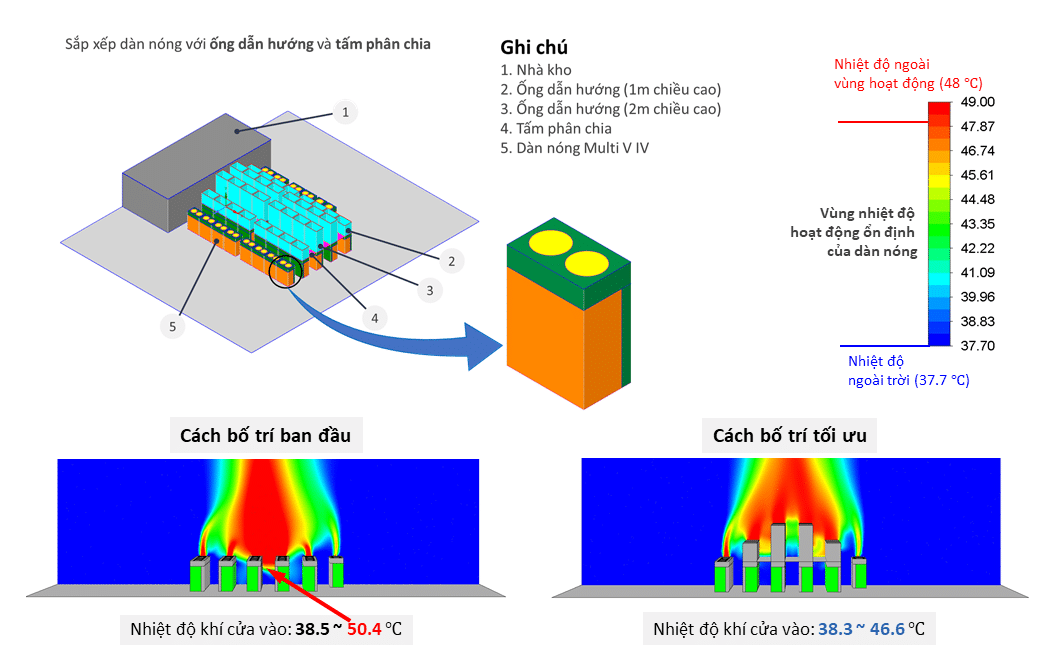
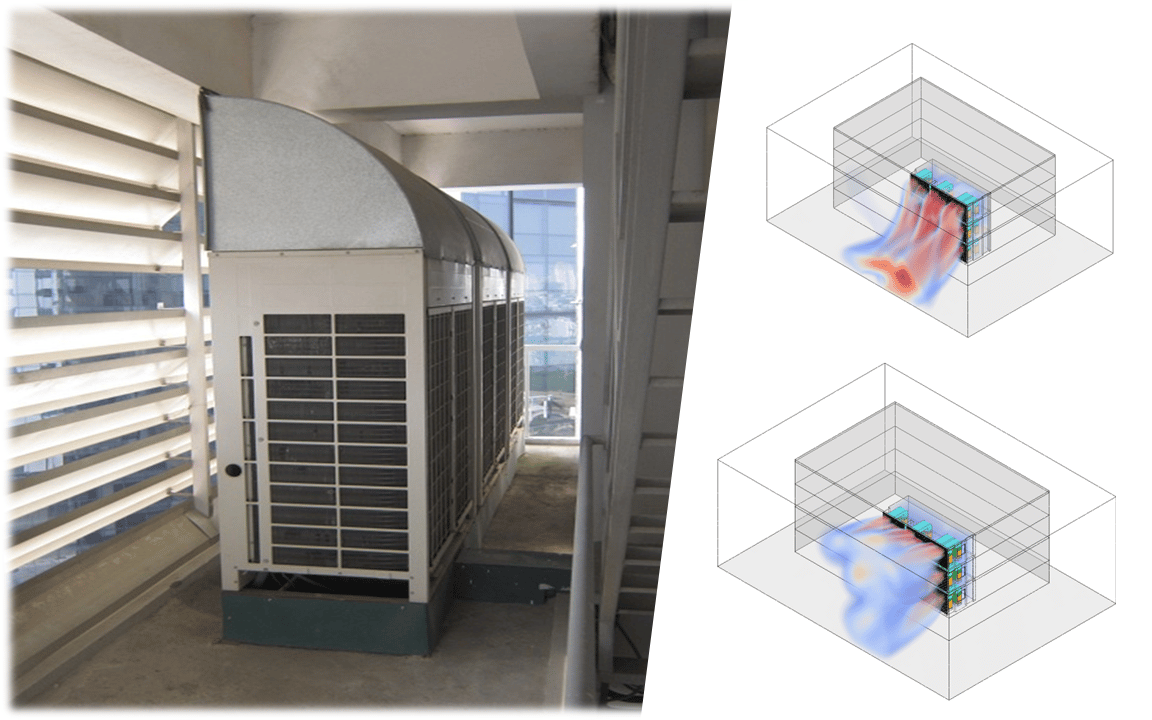
Optimizing the condenser unit layout of an air conditioning system [source]
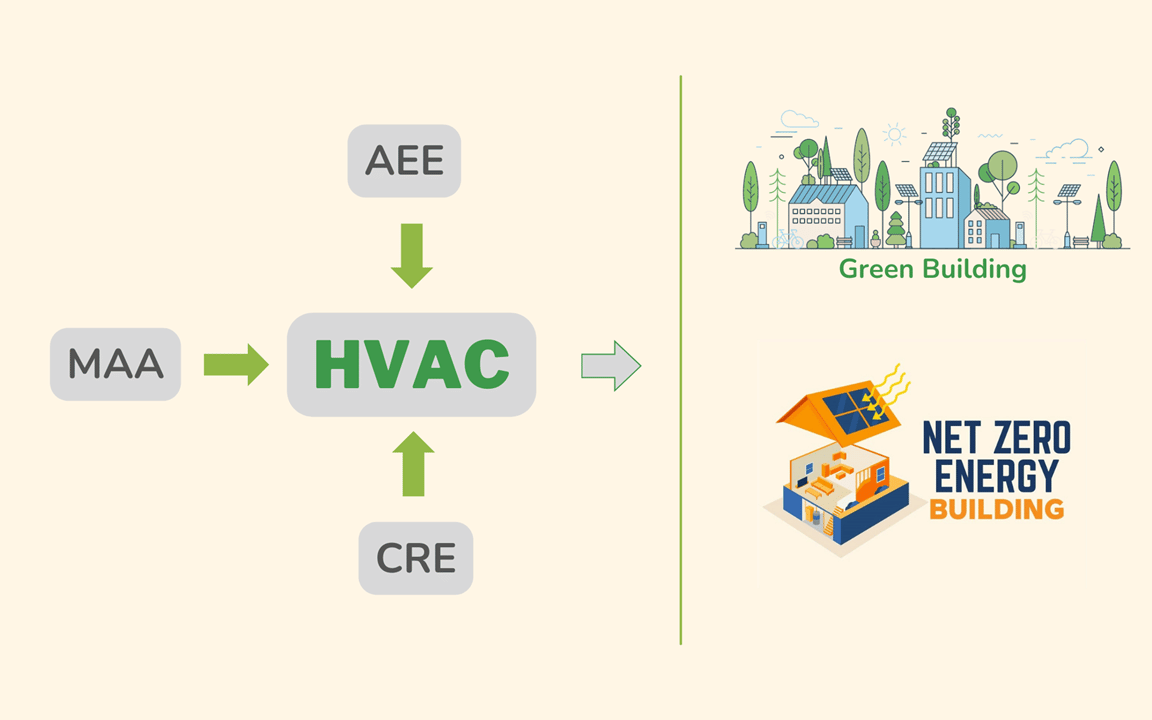
Conclusion: combining CFD and HVAC is a promising route to sustainability
Bringing CFD into HVAC saves time, cost and operating energy while raising the technical standard of the result. CFD will be one of the most useful tools in HVAC design calculations, helping meet green building and sustainability criteria.
In the future, combining CFD with cloud computing and virtual reality technology (VR, AR) will help engineers design faster and more effectively, while giving clients a realistic view of the HVAC system before and after it runs. CFD also has the potential to combine with the internet of things (IoT) and digital twins in controlling and optimizing HVAC systems.
Follow the CFDWAYS Blog for further articles on how CFD simulation is applied in HVAC and the value that combination brings to industry and everyday life.