SolutionsDigital twin & Engineering AI
Pillar 3 · Solutions

Digital twin & Engineering AI

A simulation project answers one question, once. Operation needs an answer every day, for that day's conditions. This pillar turns the engineering model into a tool that keeps running.

Foundation

Building the digital twin

A digital twin here is a validated engineering model, connected to operating data and fast enough to answer while the decision can still be made.

A validated base model

It starts from a CFD or system model calibrated against real measurements. Without that step, everything that follows is only automated guesswork.

Connected to operating data

Existing plant measurement channels feed the model as boundary conditions, so it reflects the current state rather than the design state.

Fast enough to be used

A model that takes three days to run cannot support operation; hence the reduction step described in the next section.

Ceramic-industry spray-drying system: the validated model was further developed into an energy monitoring digital twin and a cyclone design tool handed over to the plant engineering team — the retrofit package paid back in under 2 years.

Read the spray-drying case study → · Custom engineering tools →

Reduced-order models (ROM)

A ROM is a condensed version of the detailed model: it retains the relationship between the inputs and the quantity of interest and drops the computation that question does not require. The result runs in seconds instead of hours.
  • When to use it: when the model has to run thousands of times — optimization, sensitivity analysis, or serving an operator interface.
  • Limitation: a ROM is only valid within the range of conditions it was built from. Beyond that range it is extrapolation, and this boundary must be stated clearly to users.
  • Validation: the ROM is always checked back against the detailed model at points outside its training set.

Simcenter ROM tools →

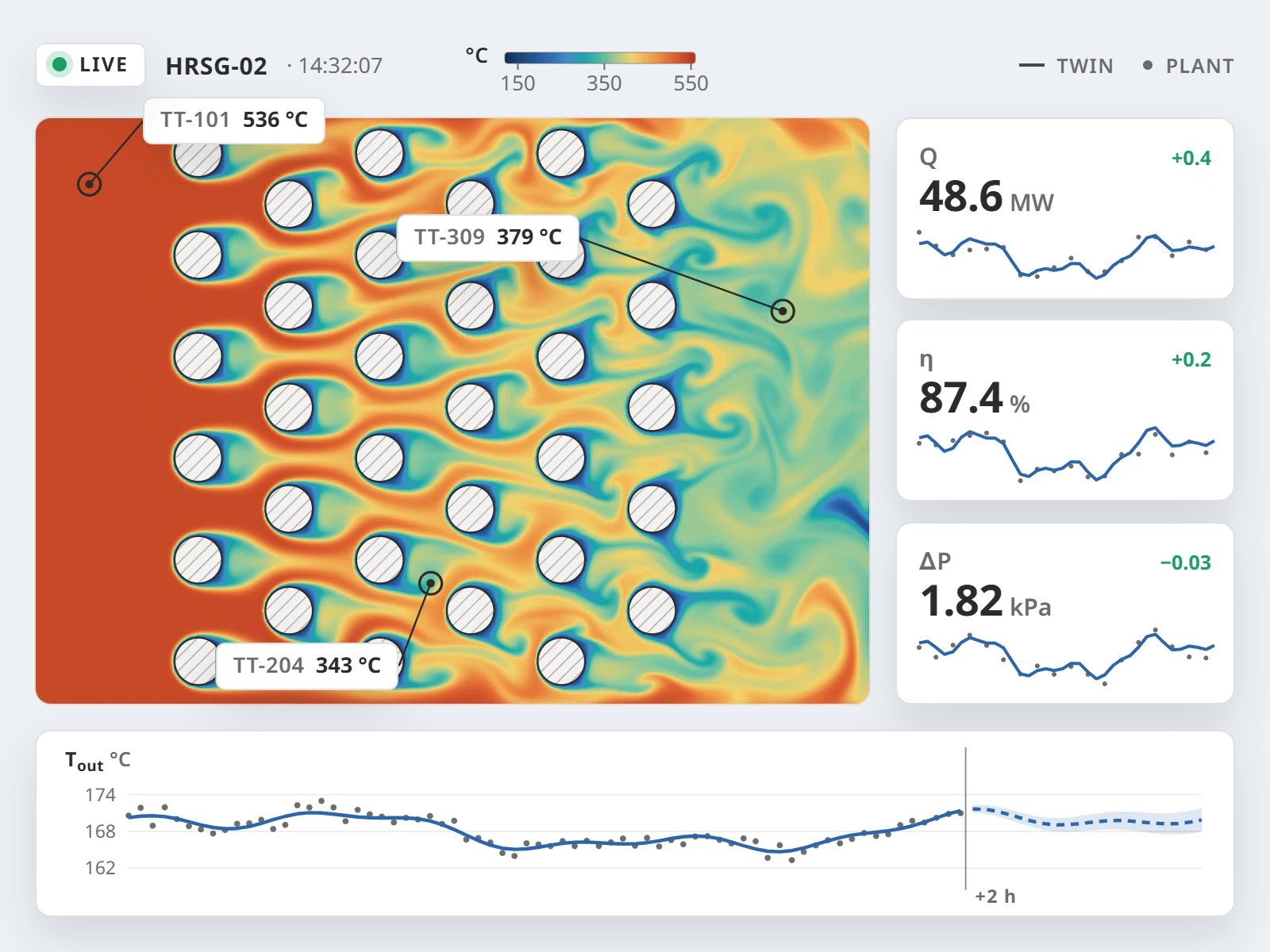
A digital twin tracking operating KPIs over time
/image/hero-digital-twin.svg4:3 ratio (landscape)
A reduced model that runs in seconds is what makes continuous KPI tracking possible.
Where AI adds value

Virtual sensors & AI-driven operation tuning

AI takes on the part the physical model does slowly: inferring what cannot be measured, searching a wide operating space, and learning from operating history.

Virtual sensors

  • Infer what cannot be measured: flame-zone temperature, concentration at the core of a reactor, stress at a hidden point
  • Early warning: when the state approaches a dangerous region the current sensors do not yet show
  • Complementing physical sensors: every inferred value comes with the conditions under which it applies

AI-driven operation tuning

  • Finding the optimal operating window: lowest consumption while satisfying emission, quality and safety limits
  • Learning from operating history: recognizing the patterns that lead to a failure or a drop in efficiency
  • AI coupled with the physical model: the physical model enforces conservation laws and material limits as constraints
The CFDWAYS team has international publications in both process simulation and machine learning, the basis for coupling AI with the physical model.

See the publication list →

What gets delivered

From a model to a tool people use

A digital twin project ends with a tool an operator can open and use straight away, with no CFD background needed.

Settle the form of delivery

An internal web application, a KPI monitoring dashboard, or a fast calculation tool for one specific equipment group.

Build it on the validated model

The model set is handed over with process documentation, so your team can continue independently.

State the boundary of application

The tool's range of validity, with a procedure for re-validation when the equipment or feedstock changes.

Training & handover

Instruction for both the operations and the engineering team, so the tool never depends on one person.

Talk to us about your equipmentTraining & skills handover

Already have a model and want to turn it into a tool?

If your equipment has been simulated before — by CFDWAYS or by someone else — the next step is usually shorter than expected. Describe the existing model and the question you need answered every day.

Send project details