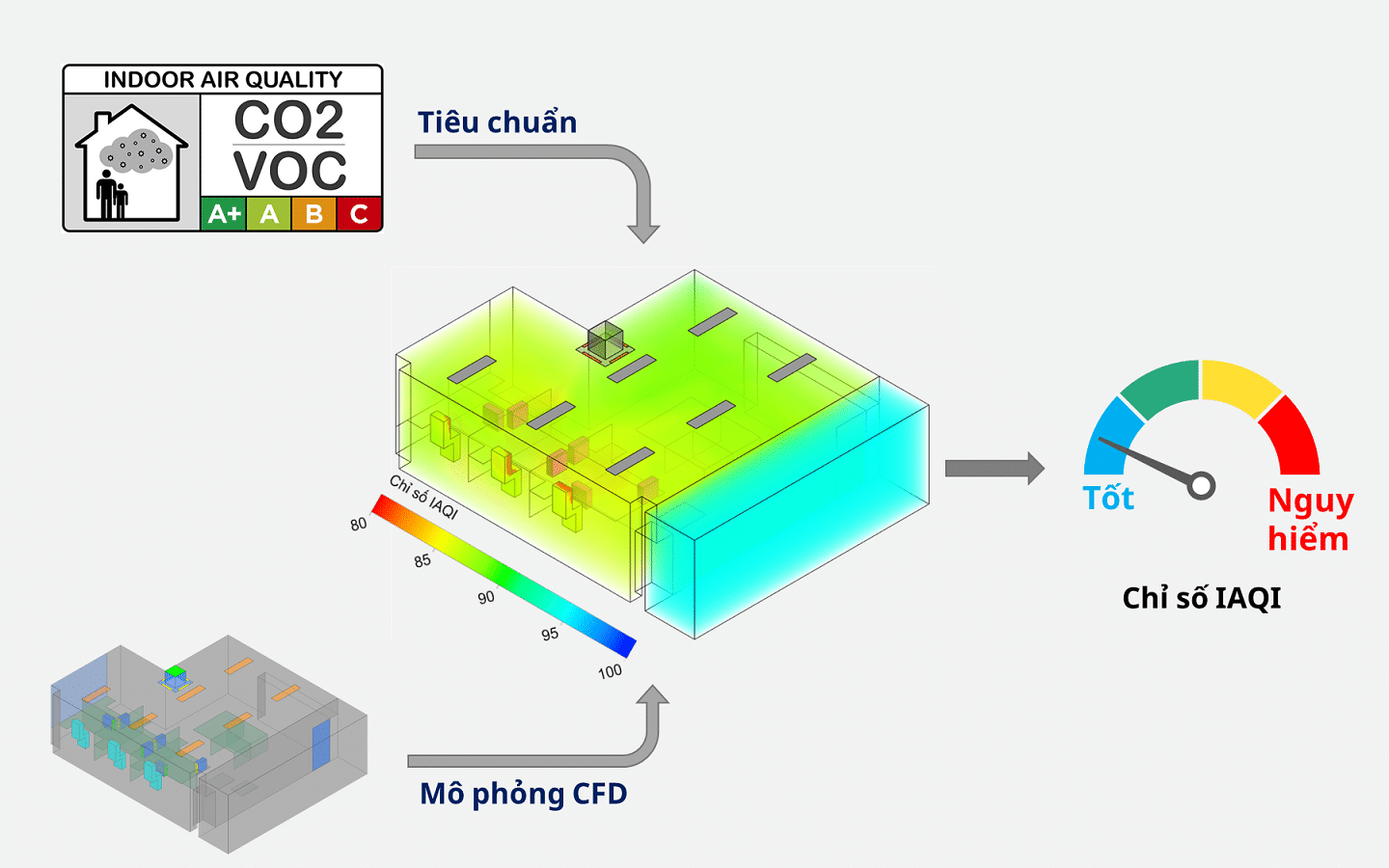
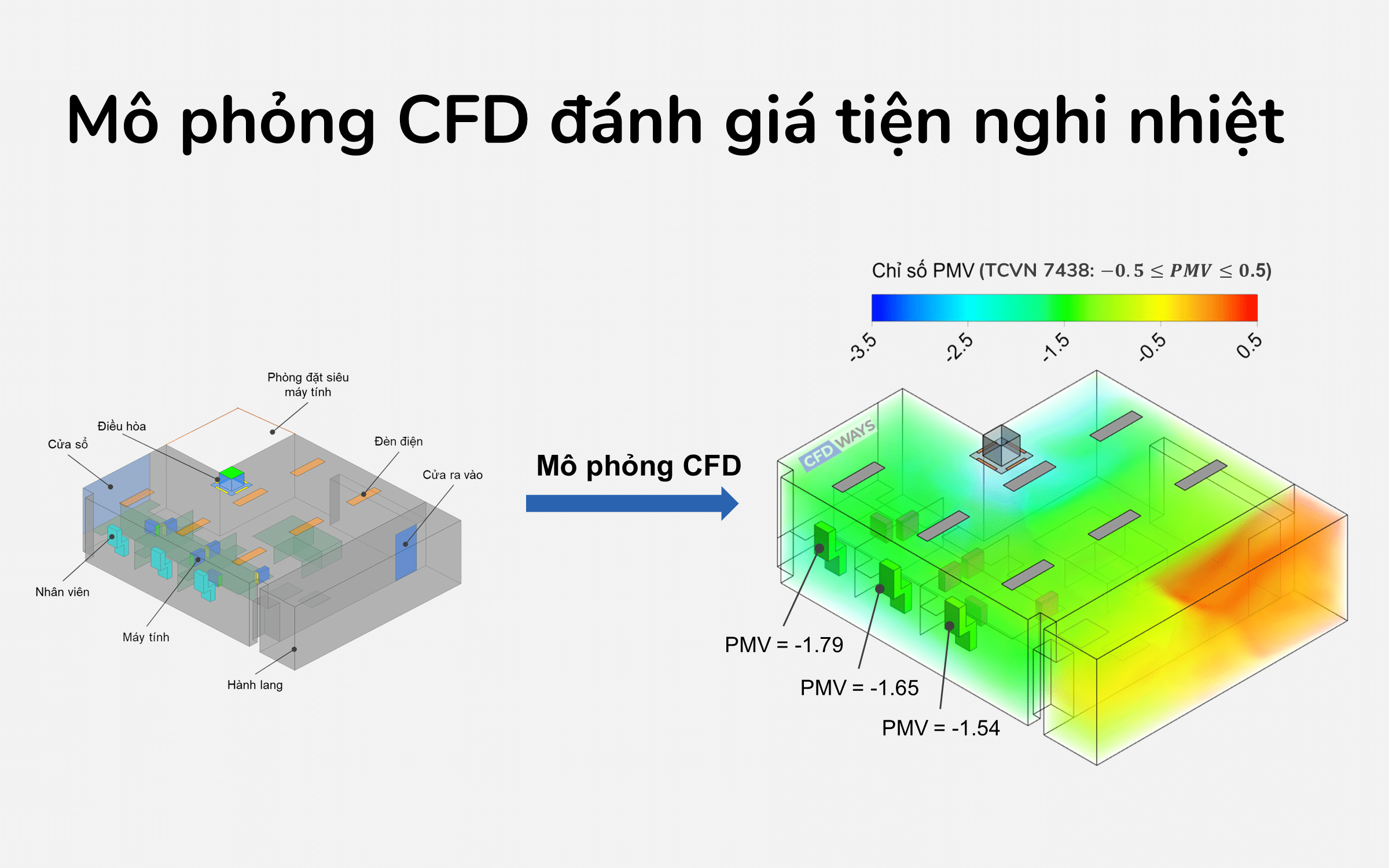
In HVAC, CFD simulation is used to identify the factors with the greatest influence on indoor air quality (IAQ) and thermal comfort, so engineers can adjust the design accordingly (source). That reduces testing cost and time and supports sound decisions before construction begins. Today CFD also helps designers improve air quality and thermal comfort without raising a building's energy consumption (source). In the context of digitalization and Industry 4.0, Vietnam's Ministry of Construction issued Circular 12/2021/TT-BXD (31 August 2021), which emphasizes intelligent control design and energy strategies for buildings, moving toward green buildings and net-zero buildings (Vietnam's commitment at the United Nations climate change summit, COP26). Balancing thermal comfort, IAQ and energy consumption is therefore a major challenge for low-energy buildings.
Beyond the air quality and thermal comfort indices set by the relevant standards and described in earlier articles, the following parameters must also be assessed to maximize ventilation effectiveness while meeting IAQ and thermal comfort standards, and so to identify ways of reducing building energy consumption:
- Mean Age of Air (MAA).
- Air Exchange Efficiency (AEE).
- Contaminant Removal Effectiveness (CRE).
With CFD, MAA, AEE and CRE can be assessed thoroughly, just like the thermal comfort and IAQ indices. To make this concrete, the article uses an office with 40 employees located at 21.0052N – 105.84452E. Weather conditions are taken for 6 June 2021 from the nearest meteorological station. The supply duct velocity is 12 m/s and the fresh air temperature 23 °C. The heat flux from each employee is 55 W/m2, and each computer dissipates 100 W. The CFD model is coupled with a thermal comfort model and a CO2 emission model for the occupants. The 3D geometry of the office is shown below.
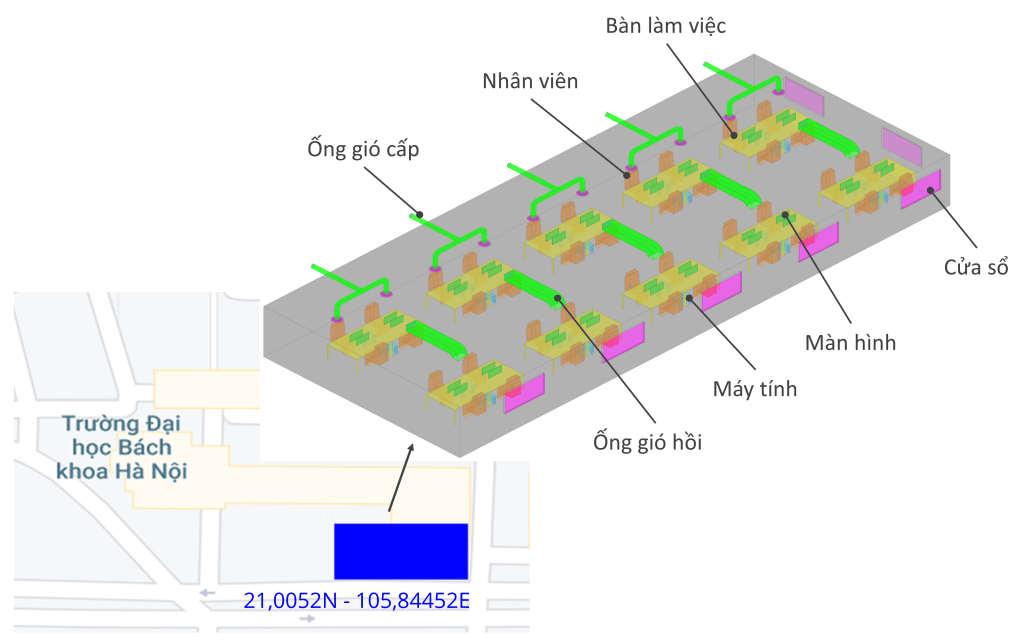
The 3D geometry of the space used for the ventilation performance simulation.
Mean Age of Air (MAA)
The mean age of air (MAA) at a point is the average time an air molecule takes to travel from the inlet (a supply grille, an air conditioning diffuser, a fan and so on) to that point in the room (source). MAA is used to compute air changes per hour (ACH or ACPH — an index directly tied to HVAC energy consumption) for one or several zones, or for the whole building. It also reveals how air is distributed between zones. As the figure below shows, the smaller the MAA the faster stale air is replaced by fresh air — but ACH rises, and vice versa. Areas with a high MAA are likely to have poor air quality and may fail on thermal comfort.
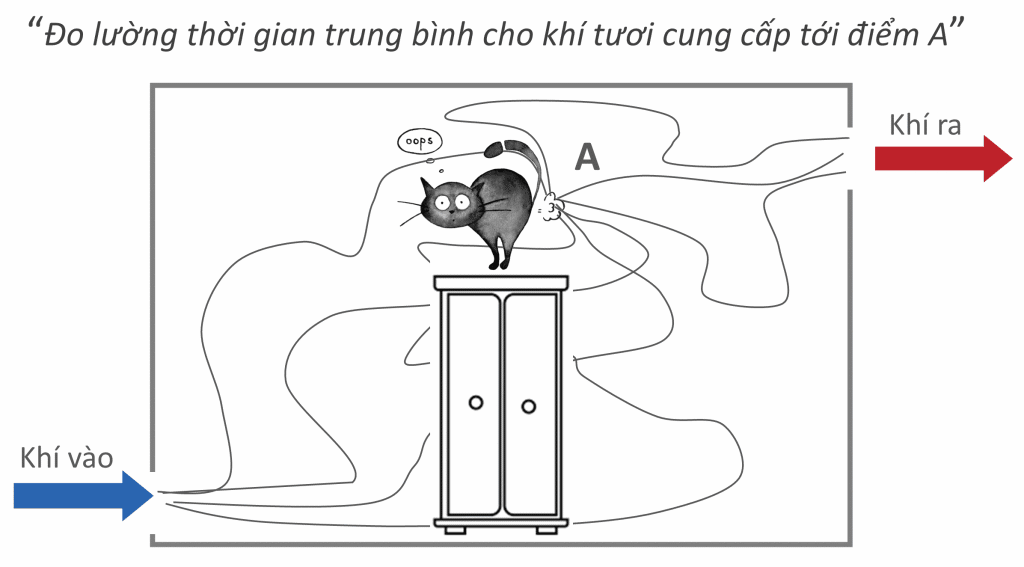
Mean age of air (MAA) explained (based on an idea from this source)
The figure below gives the CFD result for MAA in the example above. Under standard TCVN 5687-2010, ACH for an office is about 6 per hour, equivalent to an MAA of about 600 s. Near the windows the MAA is high (> 300 s), twice that of the opposite zone, showing less fresh air reaches there and more of it is drawn out through the return. Even so, the largest MAA anywhere in the office is only half the value the standard implies — equivalent to an ACH of about 12 per hour. The HVAC system is therefore consuming at least twice as much energy as it needs to in order to meet the standard.
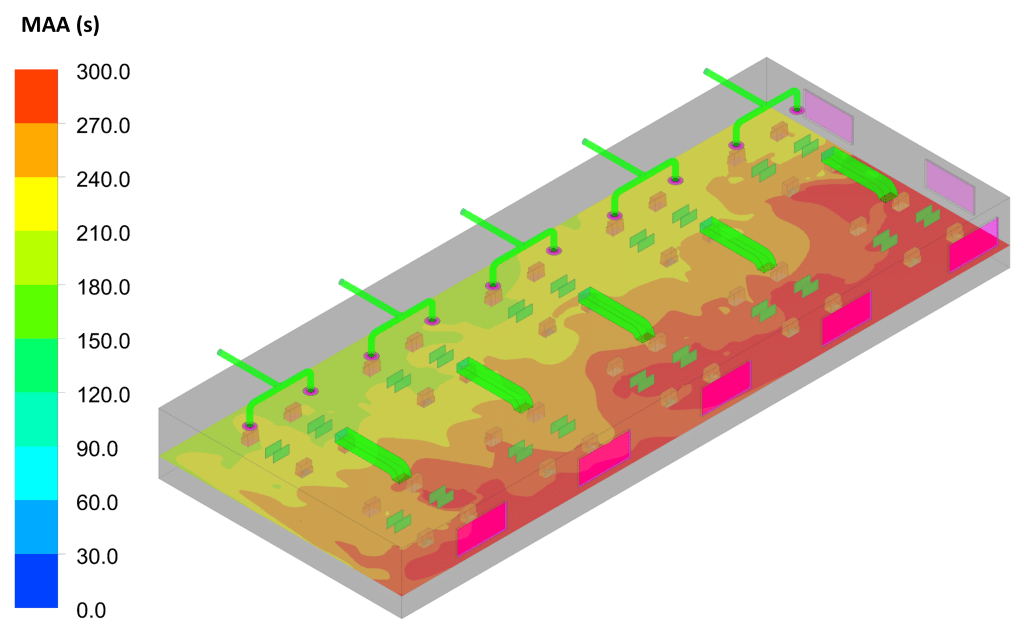
MAA distribution in the office working zone (0.8 m height)
Air Exchange Efficiency (AEE)
Air exchange efficiency (AEE) is defined as the ratio between the theoretical MAA (the room volume divided by the fresh air flow rate) and the average MAA (source). AEE measures how effectively the ventilation system replaces stale air with fresh air. As the figure below shows, the higher the AEE (> 1) the more often stale air is replaced — meaning effective ventilation, but a higher ACH, and vice versa. As with MAA, areas of low AEE (< 1) will have poor air quality and may fail on thermal comfort.
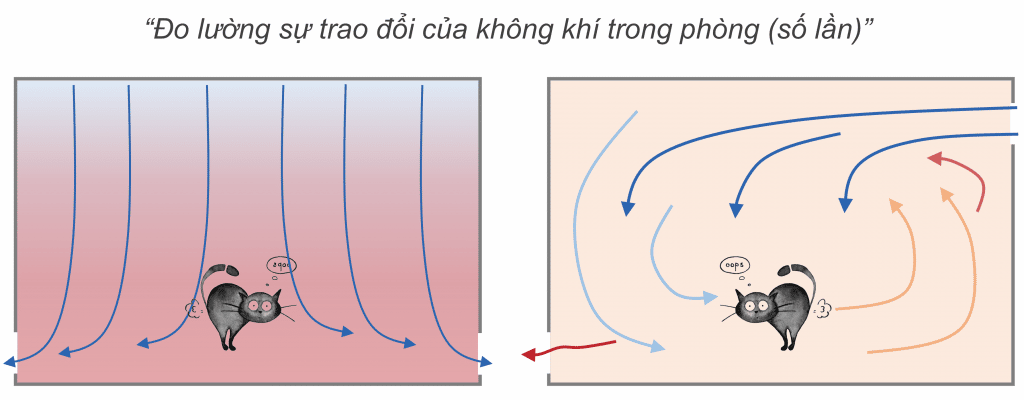
Air exchange efficiency (AEE) explained (based on an idea from this source)
The AEE result for the same example is shown below. The AEE near the windows is immediately visible as lower than elsewhere, meaning that zone is less well ventilated. Very little of the space has AEE below 1, so the office's air exchange efficiency is very good. The highest AEE is around 1.8–2 in the zone opposite the windows, equivalent to roughly twice the necessary fresh air flow being supplied. With AEE above 1 almost everywhere, the HVAC system is consuming more energy than it needs to.
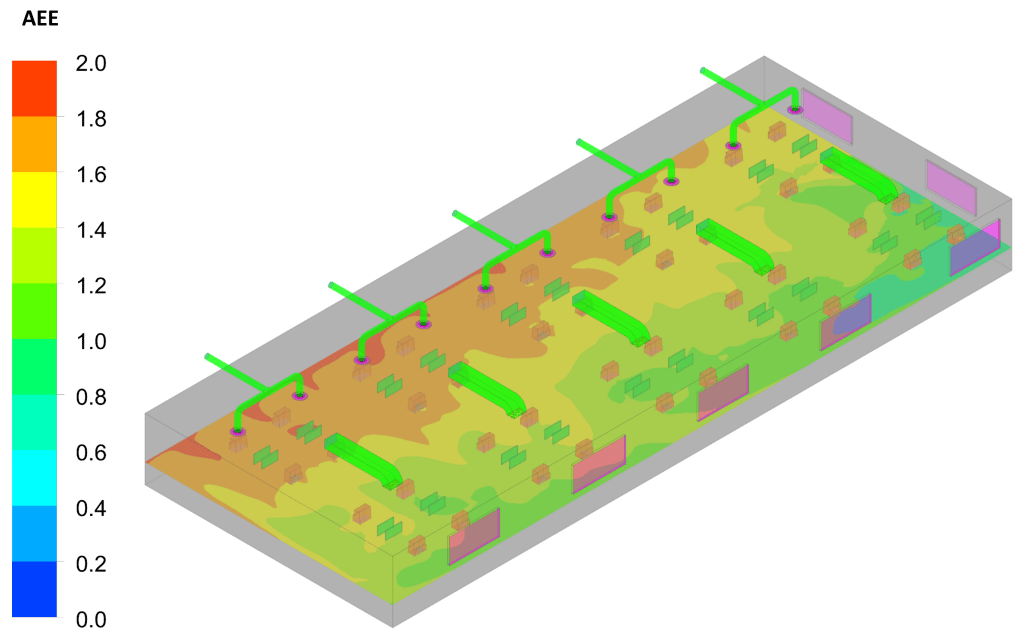
AEE distribution in the office working zone (0.8 m height)
Contaminant Removal Effectiveness (CRE)
Contaminant removal effectiveness (CRE) at a point in the room is the ratio of two concentration differences: (1) the contaminant concentration difference between the exhaust duct and the contaminant source, and (2) the contaminant concentration difference between the point of interest and the source (source). CRE measures how clean the room air is compared with the exhaust air (see the figure below). In the breathing zone, CRE must be greater than 1. The higher the CRE, the more of the contaminant travels to the exhaust rather than into the breathing zone, and vice versa. Raising ACH raises CRE, but the HVAC energy consumption rises with it.
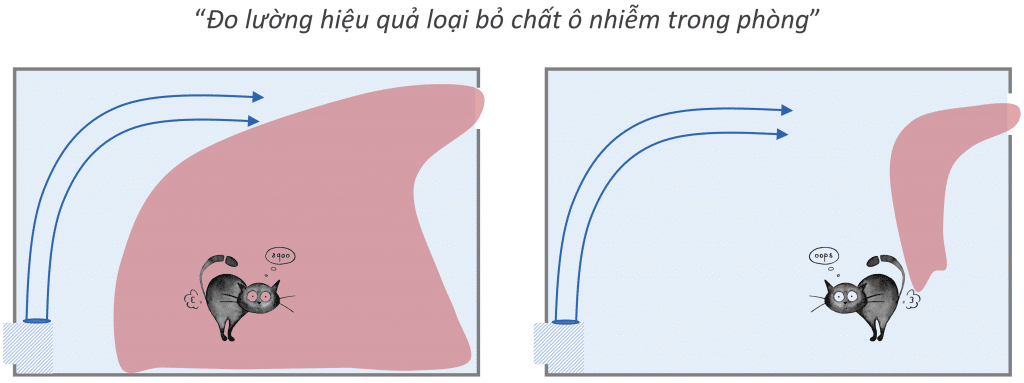
Contaminant removal effectiveness (CRE) explained (based on an idea from this source)
The CFD result (below) shows CRE — with CO2 as the contaminant — distributed evenly through the room and far above 1 (CRE = 90–100). That shows the fresh air supply is in surplus and could be reduced.
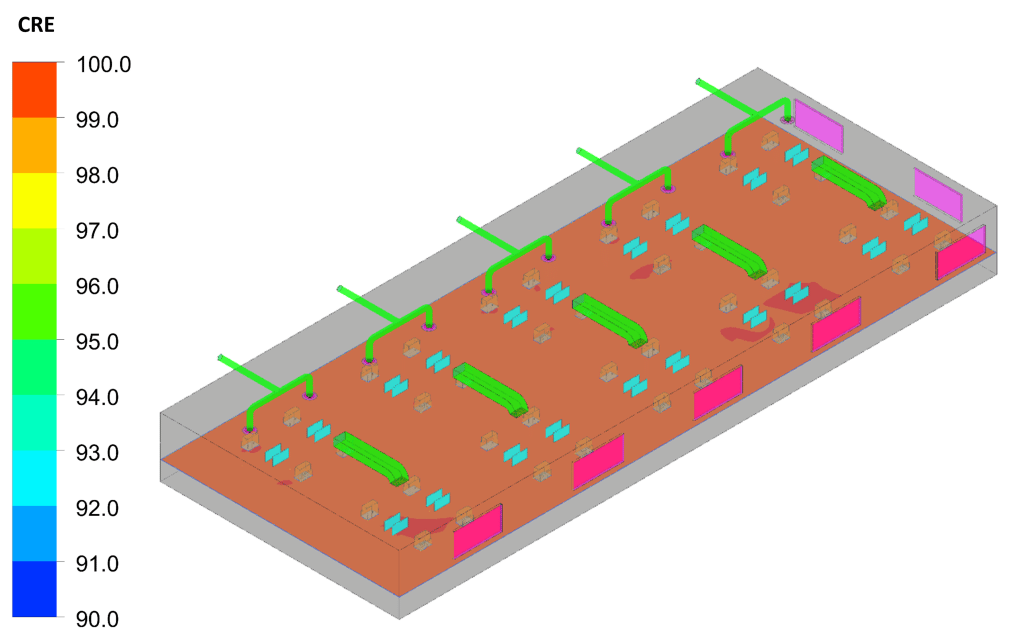
CRE distribution in the office working zone (0.8 m height)
Conclusion
The example shows fresh air being distributed in surplus and unevenly through the office, which means HVAC energy consumption can be reduced by changing the MAA, AEE and CRE indices (some options are given in the table below). To achieve good ventilation effectiveness at low energy consumption, the combination of a lower ACH and repositioned supply and return grilles can be used.
| Design option | MAA & AEE | CRE | Energy use |
|---|---|---|---|
| 1. Change the ACH (air changes per hour) | ★ | ★ | ★★★★ |
| 2. Move the supply and return grilles | ★★ | ★★ | ★ |
| 3. Add local ventilation | ★★★ | ★★★ | ★★★ |
| 4. Change the number of grilles and/or distribute them evenly | ★★★ | ★★★ | ★ |
| 5. Isolate the pollutant source | – | ★★★★ | – |
| 6. Add local air cleaning | – | ★★★★ | ★★ |
| 7. Combine (1) with one of the other options | ★★★★ | ★★★★ | ★★★★ |
The number of ★ shows the degree of influence: the more ★, the greater the influence.
CFD simulation of MAA, AEE and CRE, together with the air quality and thermal comfort indices, has the potential to help engineers design buildings with low energy consumption that still meet thermal comfort and air quality standards. With a Vietnamese grid emission factor of about 0.85 tonnes CO2/MWh, saving 1 kWh keeps 0.85 kg of CO2 out of the atmosphere. Lower energy consumption therefore cuts both the energy bill and CO2 emissions, contributing to the net-zero trend and to the COP26 goals.