IndustriesChemical engineering
Group 2 · Process industry

Chemical engineering

Process equipment is where CFDWAYS has its deepest academic foundation — with international publications on bubble columns, hydrocracking and reforming.

50+
scientific publications
Multiphase
gas – liquid – solid
Reactions
catalytic & homogeneous
RTD
residence-time analysis

Common problems

  • Poor mixing inside the reactor — part of the reaction volume takes almost no part in the process and conversion falls below design
  • Poor gas phase distribution — bubbles channeling instead of dispersing evenly, reducing contact area
  • Local hot spots — with exothermic reactions, overheated zones damage the catalyst and create by-products
  • Uneven drying — under-dried and overheated particles in the same batch
  • Erosion and fouling — unplanned shutdowns for cleaning

Why simulation is needed

Process equipment is usually closed, pressurized and running hot — sampling inside it is very limited. Inlet and outlet measurements give the overall efficiency, but not the reason it is low.

Simulation shows the velocity field, phase distribution and concentration at every position, so it points at what needs fixing instead of replacing the whole vessel.
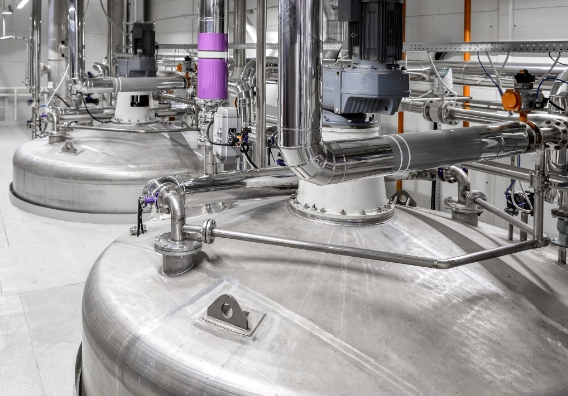
Simulation of a reactor in chemical engineering
/image/nganh-hoa-hoc.jpg4:3 ratio (landscape)
Phase distribution inside a reactor — the basis for judging mixing quality.

Equipment & processes we simulate

Reactors

Bubble columns, fixed beds, catalytic reactors, stirred tank reactors.

Separation & mixing equipment

Distillation, absorption, cyclones, phase separators, impellers and mixing tanks.

Drying & cooling

Spray drying towers, fluidized-bed dryers, coolers and heat exchangers.

Fluid machinery

Industrial pumps and fans — characteristics and losses under real operating conditions.

Simulation methods

  • Euler–Euler multiphase for bubble columns and fluidized beds
  • Lagrangian particle and droplet tracking for spray drying and catalyst injection
  • Homogeneous and heterogeneous chemical reactions coupled with heat transfer
  • Porous media for packed beds and fixed catalyst layers
  • Residence-time distribution (RTD) analysis to quantify dead zones and short-circuiting

What you receive

  • Velocity, phase distribution and concentration fields at the key sections
  • RTD curves with the percentage of volume taking no part in the reaction
  • A quantitative comparison between the current state and each retrofit option
  • Specific recommendations on dimensions, inlet positions and impeller configuration

How we work

Collect the data

Equipment drawings, operating conditions, fluid properties.

Build & calibrate

Checked against field measurements before the results are used.

Test the options

Retrofit options run in parallel and compared quantitatively.

Hand over

Report, recommendations and model files you can reuse.

Academic foundation

Scientific publications

Molten-metal bubble columns, hydrocracking, reforming — the foundation of the models used in projects.

See the publications →

Spray drying case study

Optimizing a spray-drying chamber: temperature distribution and droplet trajectories.

See the case study →

Separation & mixing capabilities

The full list of equipment and methods CFDWAYS can handle.

See the capabilities →

Is your reactor falling short of its design performance?

Send the drawings and operating data — CFDWAYS will assess whether the problem lies in mixing, reaction or heat transfer.

Send project details

Other industries: Environmental engineering · Energy, oil & gas · HVAC & building design
