Siemens softwareSimcenter ROM
Siemens Digital Industries Software · Simcenter

Simcenter ROM

Turning a CFD model that runs for hours into one that answers in milliseconds — fast enough to run alongside the real equipment as the basis for a digital twin.

ms
response time
From CFD
learned from existing results
Twin
runs alongside the real plant
VN
local engineering support

The core idea

A model learned from simulation

CFD is run across a range of operating conditions; the ROM learns the relationship between inputs and results and interpolates for any condition inside that range.

Fast enough to run online

Because it answers almost instantly, a ROM can be coupled to sensor data to estimate quantities that cannot be measured directly inside the equipment.

Only valid inside the trained range

Outside the trained range, the results are no longer reliable; designing that range is therefore the most important part of a ROM project.
Applications

  • Equipment digital twins — estimating internal temperature or concentration fields from operating data
  • Operational support — early warning when the equipment moves into an unfavorable operating region
  • Internal tools — putting the model into a spreadsheet or a web application for people who do not use CFD
  • Real-time optimization — sweeping adjustment options during the operating shift itself
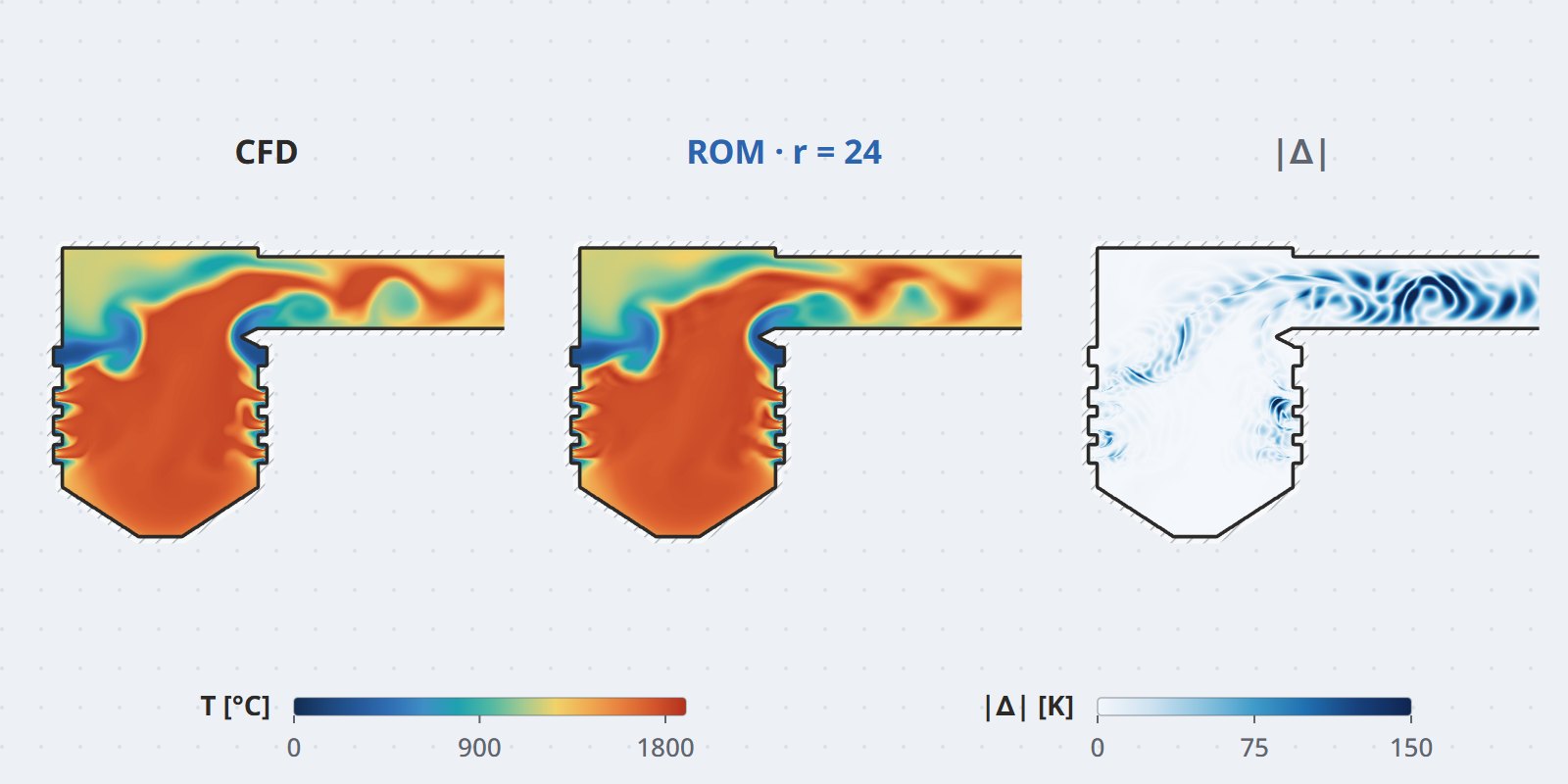
A reduced-order model running in real time inside a digital twin
/image/phan-mem/rom.jpg2:1 ratio (landscape)
The reduced model answers almost instantly, so it can run alongside the real equipment.

Coupled tools

Simcenter STAR-CCM+

The source of training data — a set of CFD results across the condition range.

View details →

Simcenter Amesim

Embedding the ROM into the 1D system model of the whole plant.

View details →

HEEDS

Generating a training set that covers the parameter space evenly.

View details →

Applications at CFDWAYS

  • Building a fast look-up tool for the operations team from simulation results that already exist
  • Estimating unmeasurable quantities: hot-spot temperature, concentration where no sensor can be placed
  • Cutting the option-assessment loop from hours to near-instant

Industries served

Licensing & support

ROM is usually supplied as part of a project and requires an existing calibrated CFD model as its data source. CFDWAYS takes the whole chain: building the base model, training the ROM, and handing over the finished tool.

Without a calibrated CFD model there is no ROM yet. CFDWAYS helps determine which step you are at.

Feasibility assessment

Frequently asked questions

Is a ROM the same thing as AI?

It does use data-driven learning, but the training data are physical simulation results. That is why a ROM keeps the physical constraints of the original problem.

How many CFD runs are needed to train it?

It depends on the number of input parameters. A few parameters need a few dozen runs; many parameters require a careful design of experiments so the number of runs stays manageable.

How long does it stay valid?

As long as the equipment geometry is unchanged and operation stays inside the trained range. A retrofit means retraining.

Want to turn existing simulation results into a daily tool?

If you already have a CFD model of the equipment, a ROM is the next step — CFDWAYS assesses feasibility first.

Send project details

See more: Digital twin capabilities · Simcenter STAR-CCM+ · The full Siemens software portfolio