Context & problem
The condensers sit on three tiers behind a louver wall, close to the neighbouring building and the generator
room. At the hottest hour of summer the outdoor air is already 41.1 °C, while the maker's maximum operating
temperature for these models is 40–48 °C. Hot air drawn back into the condensers pushes them outside that
range.
Approach
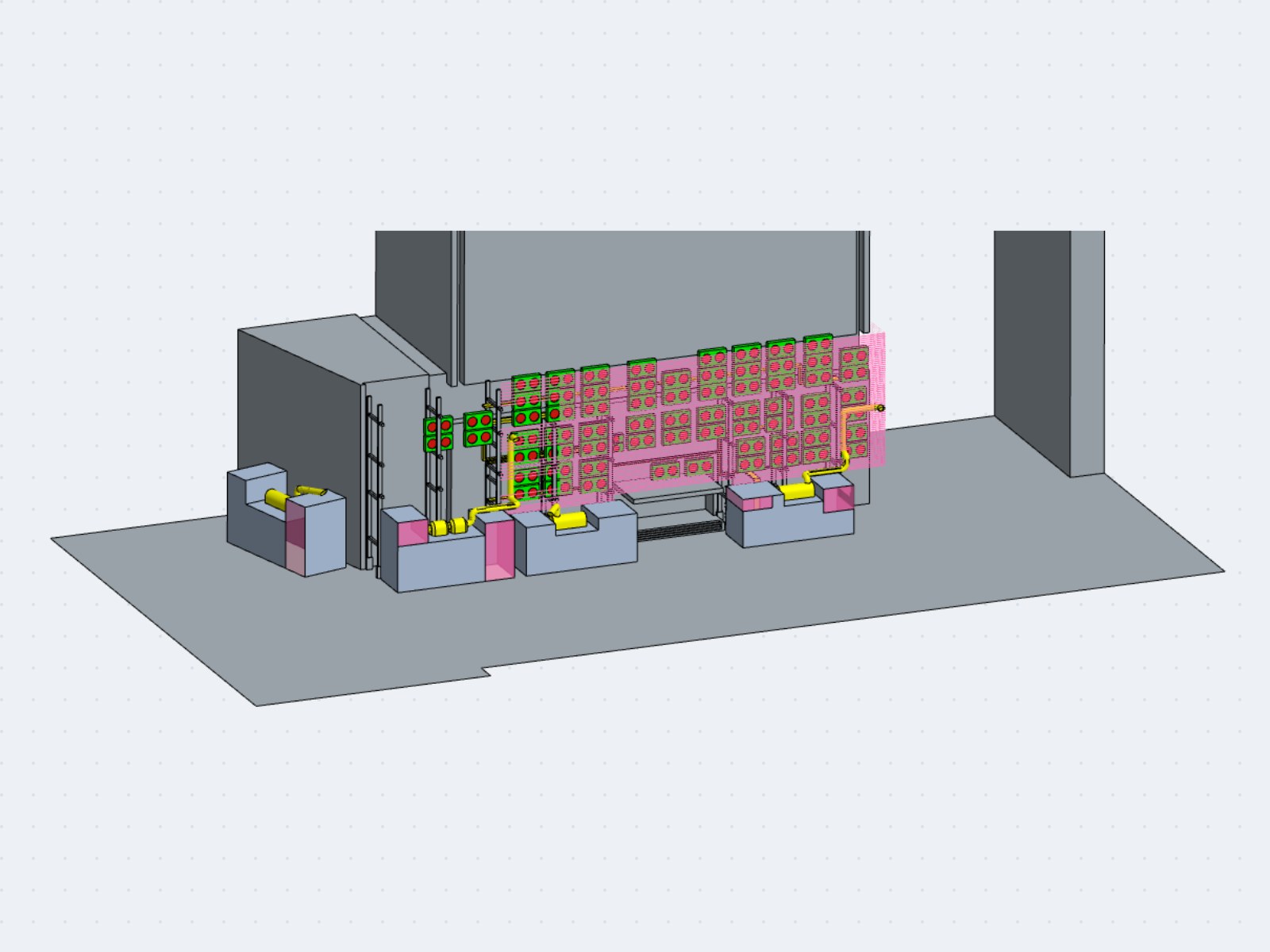
- 3D model of the building, the neighbouring building, the louver wall, cable trays, generator room and stack,
from the drawings and site survey measurements.
- The harshest case: 1 pm in summer, 41.1 °C, west wind at 1.5 m/s (surveyed on 30/06/2025), solar radiation of
1,283 W/m² for the site coordinates; all condensers, fans and the generator at 100% load (exhaust at 519 °C,
385 m³/min).
- Each condenser is a heat source with a fan from the catalogue (94–154 kW, 28,000–31,600 m³/h); the inlet air
temperature of every unit is checked against the maker's maximum.
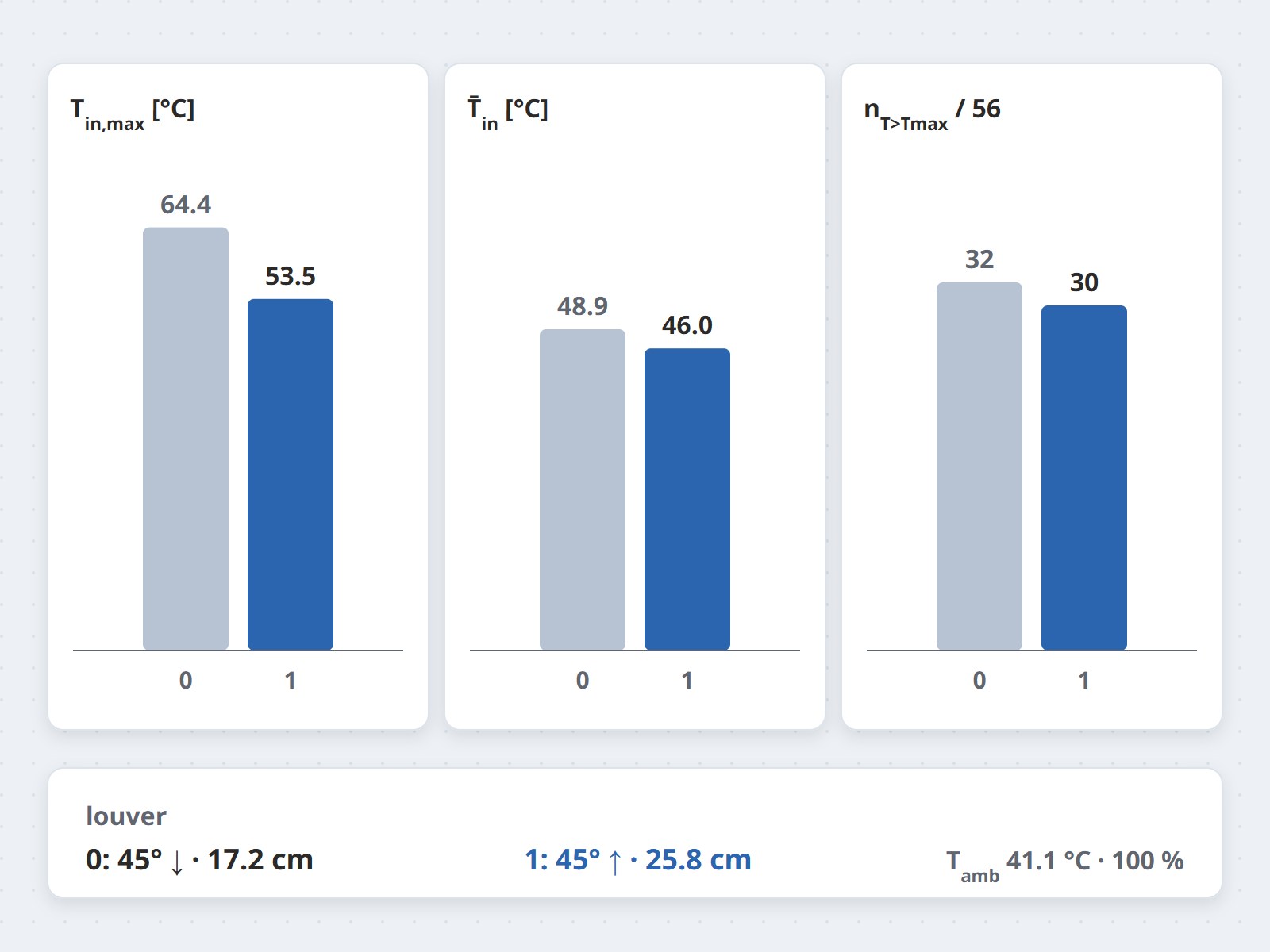
- Design 1: louvers turned upward at 45°, blade pitch widened from 17.2 to 25.8 cm, generator stack redirected.
Results
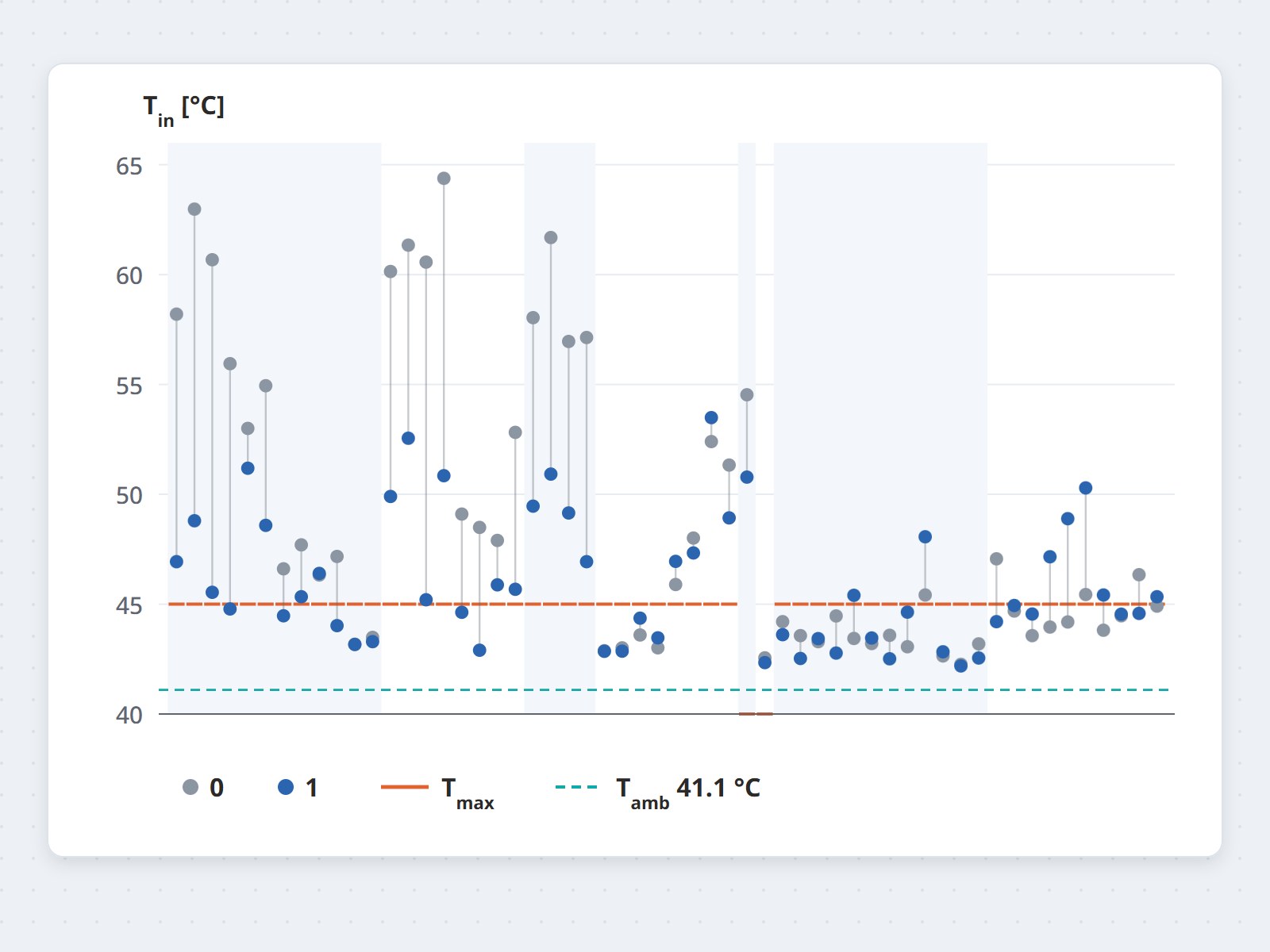
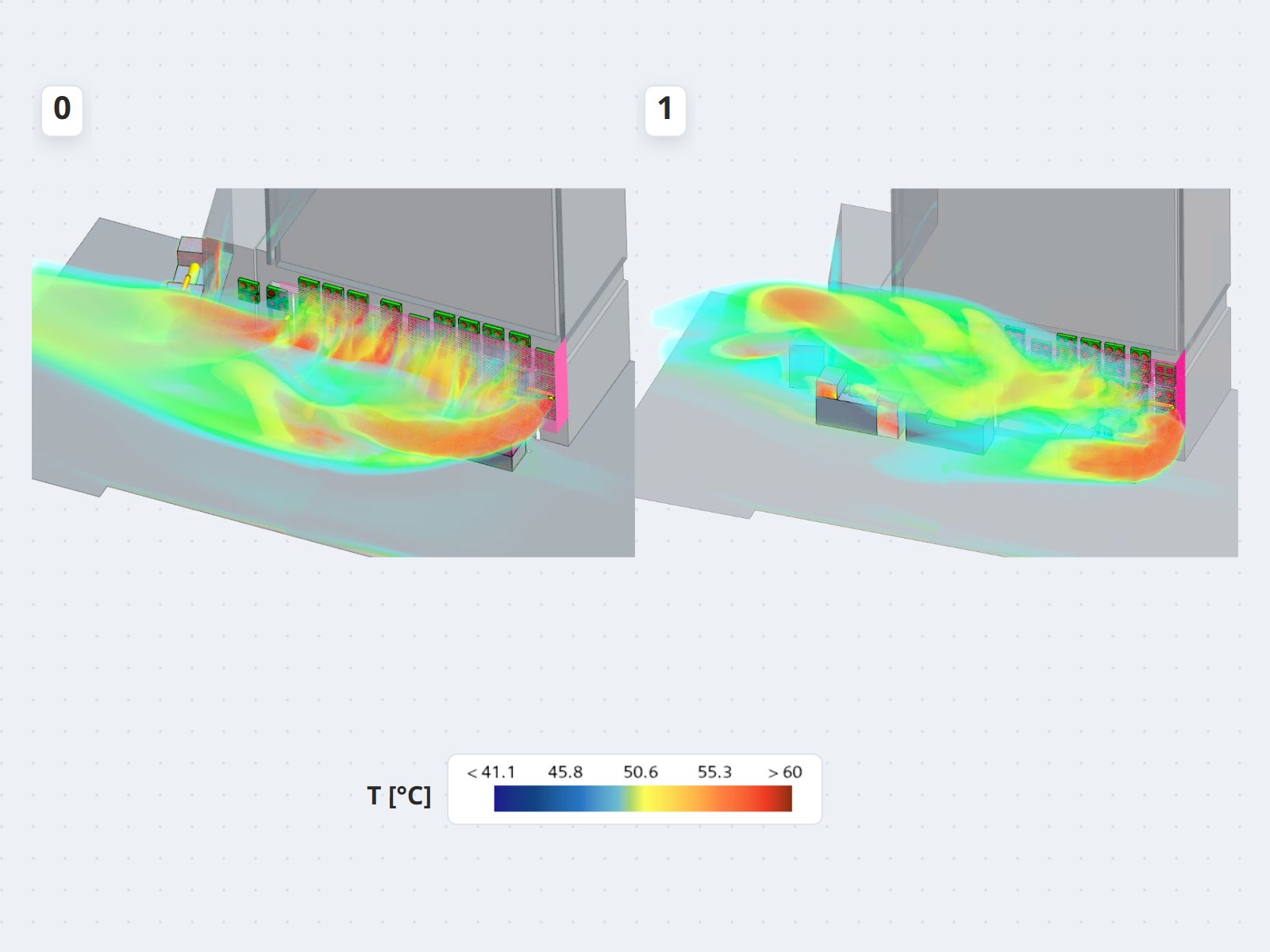
- Original design: the downward louvers hold part of the air leaving the tier-1 condensers and turn it back
into the inlets; highest inlet temperature 64.4 °C, 32 of 56 condensers above the maximum operating
temperature. The tier-3 condensers are hardly affected.
- The generator exhaust makes a zone above 100 °C around the stack, at a height and location that affects
neither people nor the condensers.
- Design 1: the warm air rises along the louvers and recirculation at the inlets drops clearly; highest inlet
temperature 53.5 °C, mean 48.9 → 46.0 °C, units above the limit 32 → 30.
- The remaining exceedances come from the harsh design case (41.1 °C, peak radiation, 100% load) and from the
west wind carrying one unit's hot air into its neighbour's inlet — the basis for the next optimization step.
Value
Changing the louver angle and pitch is a small structural change, yet it lowers the highest condenser inlet air temperature by almost 11 °C. The per-unit table of inlet temperatures shows exactly which positions still require improvement.